


The Dances
Each dance is performed by eight or ten couples, accompanied by the live orchestra of almost ten musicians.
Following, a brief presentation of the choreographies of the group Urbanitas.
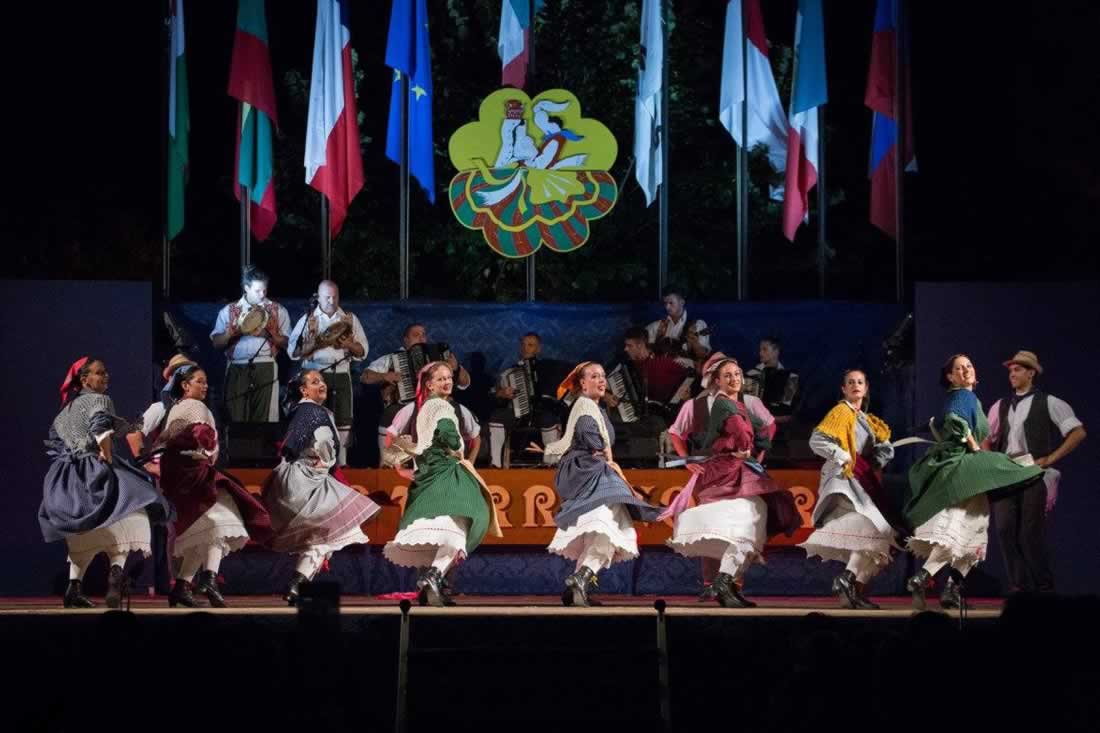
The so-called dance “Sterpe”, rapid and engaging, was born in the 70s from the work of choreographers, who brought back to light some dance moves survived from the past. It is based on the music of polka, which was very diffused in the rural communities of Marche during the 50s.

The “Manfrina” originated in the French court, where it was already widespread during the 18th century and set to music by string instruments. Thanks to the intermediation of servants of the local nobility, this music was introduced in Italy in the same century. Encountering the native folklore of the various Italian regions, the “Manfrina” took differents forms and rhythms. The version proposed by the group Urbanitas preserves still today the figure of the “maestro d’orchestra”, a male dancer who conducts aloud changes and passages of partners.

The “Mazurca” was born in Poland in the 16th century, as a popular ball. It spread also in Europe and during the Napoleonic era, it was introduced in central northern Italy, where it underwent regional personalizations.

“Vallate Vallerì” (translated “dance dancers”) was the initial dance, with which the parties at the farmer’s house began: all sharecroppers were invited to participate, honoring the landlady or the farmer’s daughter.

The “Piazza de Montegallo” was usually performed on the feast of the patron saint. It is characterized by a rapid pace of vaults, accompanied by a homonymous song, which has as protagonist the farmer’s daughter who cannot find the right dress to participate in the party organized in the square of the hypothetical village named Montegallo.

The “Montagnola” is based on a simple, but at the same time engaging, choreography. It tells the love story between a girl from the mountains, the “montagnola”, and a sailor, separated by the distance between the two different cultures. The ball is accompanied by a song, which is divided in two parts and sang by two choirs, a female and a male one. The female dancers perform holding a jug, decorated with handmade paintings, respecting the ancient tradition.

The repertoire follows with “Tre zumpi sull’ara” (“three jumps on the farmyard”), which is the result of research of the 80s, following the rhythm of the waltz. The denomination of this dance alludes to the joy of having finished the agricultural works.

Finally, there is the “U vallu che non va vè” (“The dance that is not good”). The name of this elegant and choreographic dance comes from the several mistakes of the dancers with less experience, that prevented a serious courtship because of the continuous exchange of couples.

The most iconic dance of Marche’s tradition is undoubtedly the “Saltarello”. It is considered as the “king of Marche’s dances”, even if it is different from village to village. It is a couple dance, rigorously accompanied by the “organetto” and the shouting of whom participates in. it is a courtship ball and the Urbanitas performs it reproducing a typical farmyard setting, where women are dedicated to spinning, crochet, embroidery and “scartocciatura” (maize processing), meanwhile men challenge each other noisily at the game of “morra” and drink wine. Between winks and provocations, couples follow one another at the center of the farmyard, performing the founding steps of this improvisation dance: “a vallata”, “o spuntapè”, “u filò”, closing with the “scarpetta” (fast and rhythmic footfall). Even if the basic steps are respected, each dancer personalizes his own variations, so that it is impossible to assist twice to the same “scarpetta”.